Trump’s OBBB and Medicaid Cuts: Fueling the Rise of Social Impact Finance
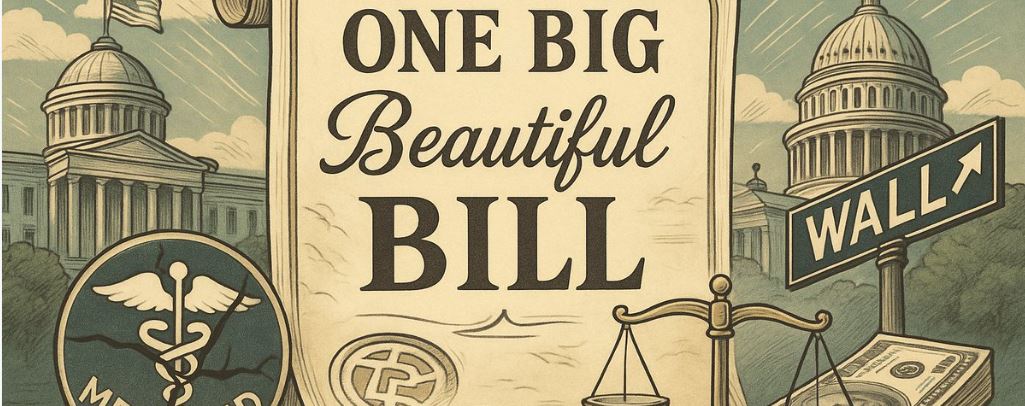
Medicaid Cuts and One Big Beautiful Bill: Making Poverty Profitable
The shift to Stakeholder Capitalism is underway as lawmakers push forward with the infamous reconciliation bill that has been dubbed the “One Big Beautiful Bill,” one provision in particular, the implementation of Medicaid work requirements, is poised to reshape public health and welfare as we know it. But not in the way you might think. Far from incentivizing employment or personal responsibility, these requirements will likely create a profitable new market for private investors through the rise of Social Impact Finance (SIF).
Welcome to the financialization of poverty.
From Entitlements to Market Opportunity
Medicaid work requirements risk making millions of poor people ineligible for health coverage. There are many who are stuck in tenuous work or encounter employment-based barriers. The consequence? An increasing population of “at-risk” people requiring services such as:
- Manpower training
- Job placement
- Behavioral health programs
- Re-entry assistance or housing
These areas are prime candidates for Social Impact Bonds (SIBs) and Pay-for-Success (PFS) contracts, the signature instruments of the Social Innovation Fund (SIF). These outcome-based financing models reward private investors based on measurable improvements, such as increased employment, reduced emergency room utilization, or lower recidivism rates. However, under current Medicaid and welfare program structures, there has been limited adoption and low demand for these financing tools. That’s where the “One Big Beautiful Bill” comes into play. With sweeping Medicaid cuts, new work requirements, and inflation compounded by rising costs from tariffs, the conditions are ripe for private investment in social programs.
That is, get people off public assistance and sell them the solution.
Compliance as a Business
When work requirements come online, states must enforce them—monitoring who’s working when and if they’re meeting requirements. Most state systems aren’t built for such complexity.
Here is where the tech and consulting groups come in:
Firms such as Palantir, Oracle, and Salesforce are already engaged with Medicaid and social service IT. Mix in behavioral science startups and AI-based compliance tools and you get another layer of bureaucratic infrastructure—financed by impact investors and repaid through “cost savings” or success indicators.
The promise: innovation and efficiency.
The reality: public governance gutted by for-profit “solutionism.”
Philanthrocapitalism as Policy Designer
Social impact finance does not operate independently. It is propelled by a constellation of “GovTech” consultants and non-profit intermediaries that craft and coordinate these deals. Consider:
- BridgeSpan for strategy
- Deloitte for impact measurement
- McKinsey for cost estimates
They arrange agreements between states, investment interests, and service providers, usually financed by charitable dollars from foundations linked with the same interests that will benefit if the program is “successful.”
It’s more of a business model than a charitable endeavor. Stakeholders invest in improvement pathways guided by data-driven decision models, which rely on the integration and aggregation of data from various government agencies. This is where social behavioral scoring becomes crucial. Recent Palantir contracts, combined with the AI components of the One Big Beautiful Bill (OBBB), are designed to deliver this advanced analytical capability.
An Already Paved Road
The groundwork for this has already been laid. We’ve seen this model in:
- SNAP Employment & Training (E&T) programs
- Reentry programs for criminal justice
- “Housing First” solutions for homelessness
- Medicaid pilots for maternal care for states such as NY, TX, and CA
Adding Medicaid work requirements just gives scope—making people’s lives “impact assets” and their challenges investment opportunities on a data-driven basis.
What’s the Risk?
This is ethically problematic and it’s institutionally risky:
- People become commodities, reduced to their data profiles.
- Private gains are wrested out of public suffering.
- Perverse incentives arise -keeping individuals just “needy” enough to keep the program going.
- Transparency breaks down, because public accountability is turned over to third-party contractors and investor coalitions (i.e. Public, Private Partnerships)
Conclusion:
It might be a coincidence, but the changes introduced in this bill closely align with the trajectory of the so-called “Great Reset.” Medicaid work requirements, often promoted as liberatory reforms, in reality impose artificial scarcity and embed monitoring mechanisms that pave the way for private capital investment in public welfare. These measures manufacture a crisis—then offer a “cure” that comes with a profit margin; while establishing a financial pipeline of impact data—making Medicaid beneficiaries profit centers within a new market for social compliance.