Behind the Fluff: How the SDGs, the Great Reset, and the WEF Are Reshaping Global Power
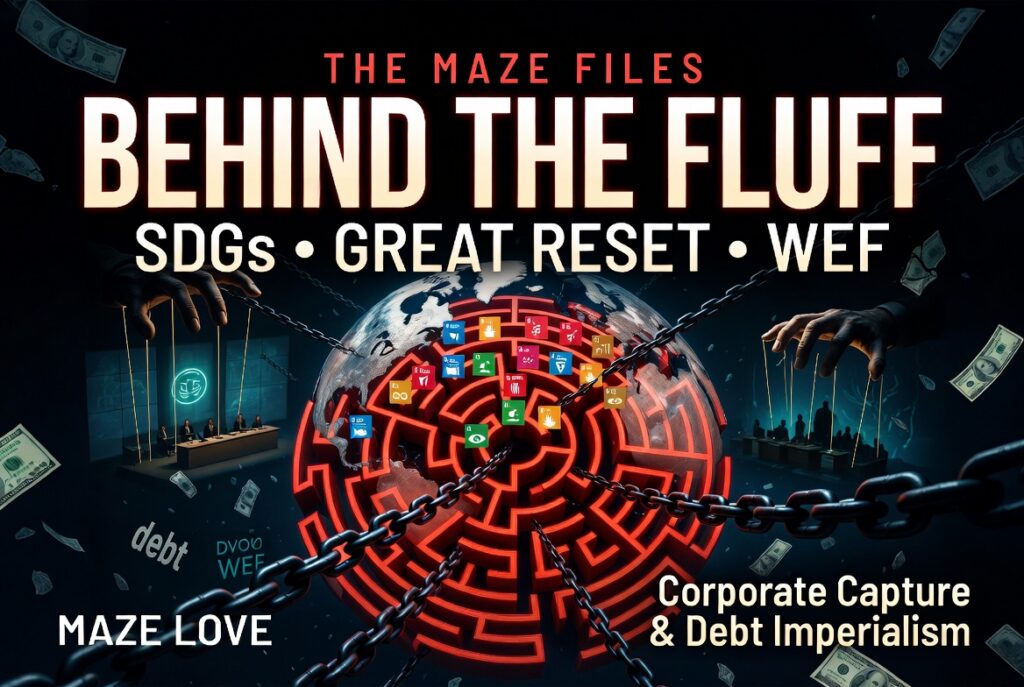
The United Nations’ 2030 Agenda for Sustainable Development, embodied in its 17 Sustainable Development Goals (SDGs), is often heralded as a utopian roadmap for achieving global peace, environmental stewardship, and universal prosperity. However, beneath the polished rhetoric lies a mechanism for debt imperialism that serves the interests of economic elites, consolidating their power at the expense of the most vulnerable.
This investigation pulls back the curtain on the interconnected architecture linking the SDGs, the World Economic Forum’s “Great Reset,” and a sweeping private-sector capture of global governance, tracing the paper trail from Davos boardrooms to the balance sheets of developing nations.
I. Manipulating ‘Macroeconomic Stability’
A cornerstone of the SDG framework is the notion of “macroeconomic stability.” Traditionally, this term has been associated with objectives like full employment, stable economic growth, and low inflation. However, the UN redefines it to emphasize the creation of “fiscal space” effectively, the ability of nations to borrow heavily in the name of sustainable development, regardless of their actual economic conditions.
This redefinition is underpinned by a “debt sustainability gap,” a malleable metric used to justify increased borrowing and taxation. This circular reasoning promotes endless debt accumulation as a solution to economic instability, creating a feedback loop where economic crises justify further indebtedness and SDG implementation. The World Bank explicitly highlights debt as a primary vehicle for financing the SDGs, cementing its role in this self-perpetuating cycle.
Key Finding: As of 2024, global public debt reached a record $102 trillion, with developing nations’ debt growing twice as fast as advanced economies since 2010, according to UNCTAD.
▸ Source: UNCTAD, Global Public Debt Report, June 2025
Research by the Group of 24 has consistently shown that developing countries pay interest rates three to four times higher than those of advanced economies, a structural inequality baked into the very system claiming to help them.
▸ Source: G-24 Director Iyabo Masha, April 2026
II. The Role of Multi-Stakeholder Partnerships
The SDG framework is operationalized through “multi-stakeholder partnerships” involving businesses, NGOs, governments, the UN, and other actors. While this collaborative language sounds inclusive, it effectively grants private multinational corporations, predatory philanthropic foundations, and unaccountable NGOs access to taxpayer-funded slush funds. These funds are used to distribute SDG-compliant products and services, often protected by government legislation crafted by the same stakeholders.
This dynamic allows private entities to dictate policy while remaining shielded from accountability, often under the pretext of addressing an urgent climate crisis. It represents a troubling privatization of governance where public interests are subordinated to corporate profits.
III. The Great Reset: A Corporate Roadmap Wearing a Humanitarian Mask
In June 2020, World Economic Forum Chairman Klaus Schwab launched the “Great Reset Initiative” — ostensibly a COVID-19 recovery plan, but in practice an accelerated blueprint for implementing the 2030 Agenda and SDGs through private-sector mechanisms.
The initiative’s three pillars, steering markets toward “fairer outcomes,” ensuring investments advance “shared goals” via ESG metrics, and harnessing the Fourth Industrial Revolution, align almost perfectly with WEF’s preexisting corporate governance agenda. As the Brookings Institution framed it: response, recovery, and reset.
Critical Quote: One article commissioned by SOMPO Holdings stated: “We need a new capitalism that increases consumer demand for goods and services that contribute to the SDGs, and that rewards companies meeting that ‘good demand’ with economic returns.” Ballotpedia, The Great Reset
Critics across the political spectrum have noted the contradiction embedded in the initiative. Ethicist Steven Umbrello, writing in the Journal of Value Inquiry, described the agenda as amounting to a “substantial socio-political-economic overhaul” that “whitewashes a seemingly optimistic future post-Great Reset with buzz words like equity and sustainability even as they functionally jeopardize those admirable goals.”
▸ Source: Wikipedia, Great Reset; Ballotpedia, The Great Reset (WEF)
IV. The 2019 UN-WEF Agreement: A Formal Corporate Capture
On June 13, 2019, before COVID, before the Great Reset launch, UN Secretary-General António Guterres quietly signed a Strategic Partnership Framework with the World Economic Forum. The stated purpose: to “accelerate the implementation of the 2030 Agenda for Sustainable Development.”
The agreement grants transnational corporations preferential and deferential access to the UN system at the expense of nation-states and public interest actors. More than 400 civil society organizations and 40 international networks condemned the agreement, warning it formalized a “disturbing corporate capture of the UN” moving the world toward “privatized and undemocratic global governance.”
Whistleblower Voice: Harris Gleckman, former UN official and senior fellow at the University of Massachusetts: “This strategic agreement is a coup for the corporate leaders at Davos, but what does it offer the UN and the international community? This gives some of the most controversial corporations unprecedented access to the heart of the UN.”
▸ Source: OpenDemocracy, How the United Nations is Quietly Being Turned into a Public-Private Partnership, 2019; Common Dreams, 200+ Groups Denounce UN-WEF Agreement, 2019
Notably, the MOU was prominently displayed on the WEF website at signing, but was nowhere to be found on the official UN website. The agreement narrowed the scope of each SDG area from the intergovernmentally negotiated goals toward positions more aligned with corporate interests. Under financing, for instance, it called only for “building a shared understanding of sustainable investing”, but contained no commitment to reducing banking-induced instabilities or corporate tax avoidance.
V. IMF, World Bank, and the New Global Financial Order
The International Monetary Fund (IMF) and the World Bank have historically functioned as financial weapons to impose policies favorable to Western interests on developing nations. These institutions are now being “reimagined” by the Glasgow Financial Alliance for Net Zero (GFANZ), a private-sector initiative comprising powerful financial entities managing trillions in assets.
GFANZ seeks to merge private banking interests with the IMF and World Bank, creating a new system of global financial governance that undermines national sovereignty. At COP26, BlackRock CEO Larry Fink, a principal of GFANZ, stated explicitly: “If we’re going to be serious about climate change in the emerging world, we’re going to have to really focus on the reimagination of the World Bank.”
The Pattern: Debt remains the primary tool of coercion. Mechanisms like ‘debt-for-conservation swaps’ have been used as facades for land grabs and resource exploitation in developing nations, effectively turning environmental pledges into leverage for foreign asset acquisition.
▸ Source: Unlimited Hangout / Z3 News, UN-Backed Banker Alliance Announces ‘Green’ Plan, November 2021
The WEF’s own 2009 Global Redesign Initiative, a 600-page document largely ignored by mainstream media, called for a new system of global governance in which decisions of governments would be made secondary to multistakeholder-led initiatives. In the WEF’s own words, “the government voice would be one among many, without always being the final arbiter.”
▸ Source: OpenDemocracy, Conspiracy Theories Aside, There Is Something Fishy About the Great Reset, August 2021
VI. The UN’s Quiet Revolution: From Multilateral to Multistakeholder
In the 1990s, the UN underwent a significant shift, embracing public-private partnerships (G3Ps) under the leadership of Kofi Annan. This pivot redefined the role of nation-state governments as “enabling partners,” responsible for creating favorable fiscal conditions for private-sector involvement.
Philanthropic foundations; Rockefeller, Gates, and others, played pivotal roles in shaping this public-private paradigm. The Gates Foundation and Rockefeller Foundation have provided core funding across multiple UN agencies and SDG-adjacent institutions, raising fundamental questions about conflicts of interest in public health, food systems, and development policy.
The pattern extends into specific sectors. GAVI (the Vaccine Alliance) and CEPI (the Coalition for Epidemic Preparedness Innovations), both with deep WEF and Gates Foundation ties, positioned themselves ahead of the COVID-19 pandemic to oversee vaccine rollout through COVAX. Though COVAX was predominantly government-funded, it was these corporate-centered coalitions, not democratic governments, running the operation.
▸ Source: People’s Health Movement, Global Health Watch 6, Chapter D5, 2023; OpenDemocracy, ‘Fishy About the Great Reset,’ 2021
Conclusion: Sustaining Power, Not People
Far from fostering environmental sustainability or equitable development, the UN’s vision of “sustainable development” commodifies the Earth and its inhabitants for a new global economy. Through a carefully constructed architecture, multi-stakeholder partnerships, SDG financing frameworks, the Great Reset, GFANZ, and the formal UN-WEF partnership, a global governance system is being assembled that answers not to democratic electorates, but to private capital.
The result: developing nations increasingly burdened with debt denominated in foreign currencies, required to open their economies to foreign investment and deregulation as conditions of SDG compliance, while the institutions managing this process, the WEF, IMF, World Bank, remain unelected, unaccountable, and increasingly entangled with the corporations they are meant to regulate.
Future installments will delve into specific case studies of individual SDGs and their real-world impacts, examining how abstract global goals translate into concrete policy conditions on the ground in the Global South.
Key Takeaways
- The UN’s 2030 Agenda redefines ‘macroeconomic stability’ to justify increased national debt and taxation, with global debt now at a record $102 trillion.
- In June 2019, the UN and WEF signed a formal Strategic Partnership Agreement to implement the SDGs, condemned by 400+ civil society groups as ‘corporate capture.’
- The WEF’s 2020 Great Reset explicitly links COVID-19 recovery to SDG implementation, using ESG metrics as the vehicle for corporate-led global governance.
- GFANZ – led by figures like BlackRock CEO Larry Fink, is actively working to ‘reimagine’ the IMF and World Bank as private-sector-aligned institutions.
- Multi-stakeholder partnerships enable corporations to access taxpayer-funded SDG financing while avoiding democratic accountability.
- Philanthropic foundations (Rockefeller, Gates) and WEF-aligned institutions (GAVI, CEPI) have captured UN health and development policy, raising deep conflicts of interest.